

Use
 for pop-ups with more detail.
 Use blue buttons with letter "i" for pop-ups with more detail.
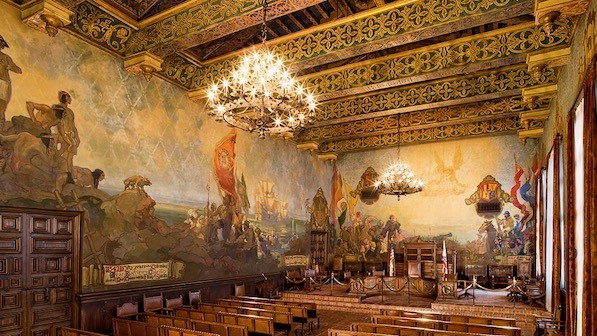
The iconic Mural Room is a Courthouse highlight, reflecting Santa Barbara’s rich past and roots in Chumash, Spanish, Mexican, and immigrant cultures. Originally the County Supervisors’ Assembly Room, it is now used for weddings, civic and social events.
The four murals were painted by Dan Sayre Groesbeck.
As shown in the Cast of Characters tour:
 The ceiling, like all others throughout the Courthouse, was painted by John B. Smeraldi.
As shown in the Cast of Characters tour:
The ceiling, like all others throughout the Courthouse, was painted by John B. Smeraldi.
As shown in the Cast of Characters tour:


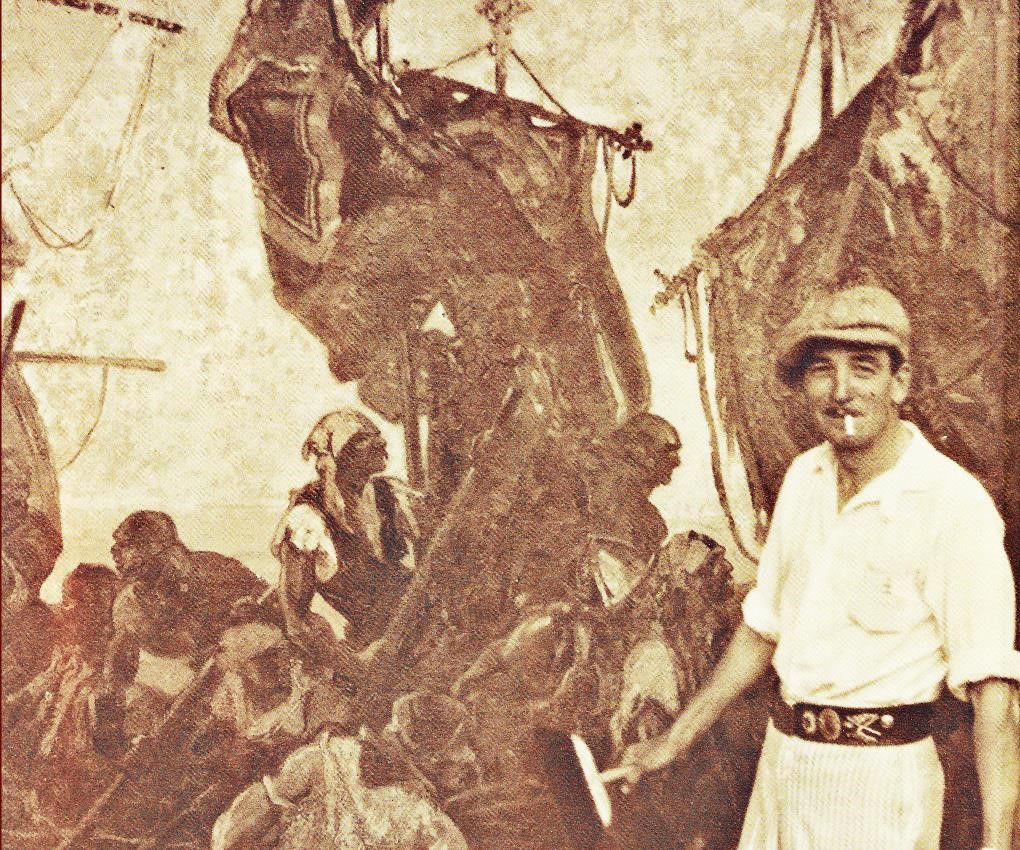
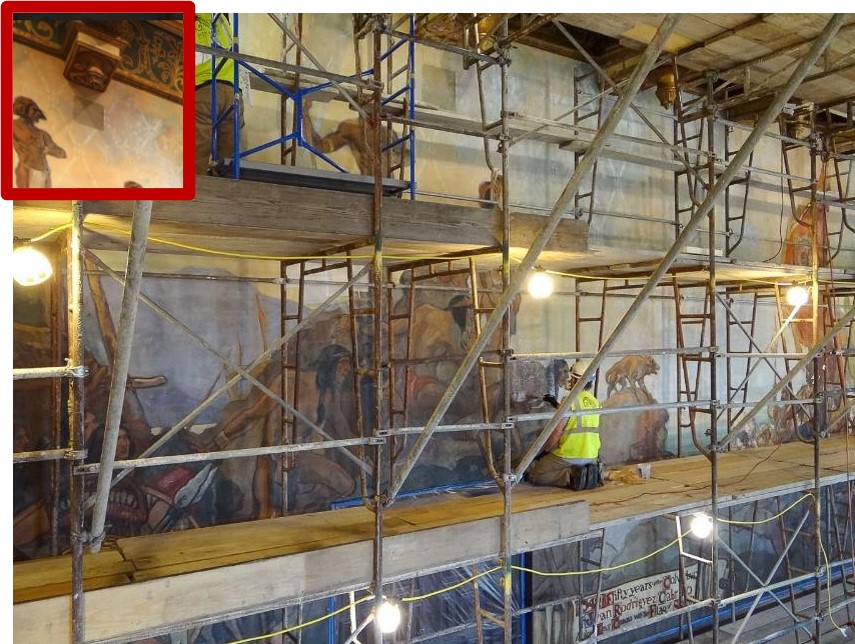 Smoke damage from an electrical fire in 2010, and from years of tobacco use, is shown in a dark patch left by the art conservators who cleaned and restored the murals at a cost of over $1 million. (Photo: Evergreene Architectural Restoration)
Note the faint diamond pattern on the muslin, which serves as a grid for scaling and positioning objects in large murals, here left unpainted in some areas.
Smoke damage from an electrical fire in 2010, and from years of tobacco use, is shown in a dark patch left by the art conservators who cleaned and restored the murals at a cost of over $1 million. (Photo: Evergreene Architectural Restoration)
Note the faint diamond pattern on the muslin, which serves as a grid for scaling and positioning objects in large murals, here left unpainted in some areas.
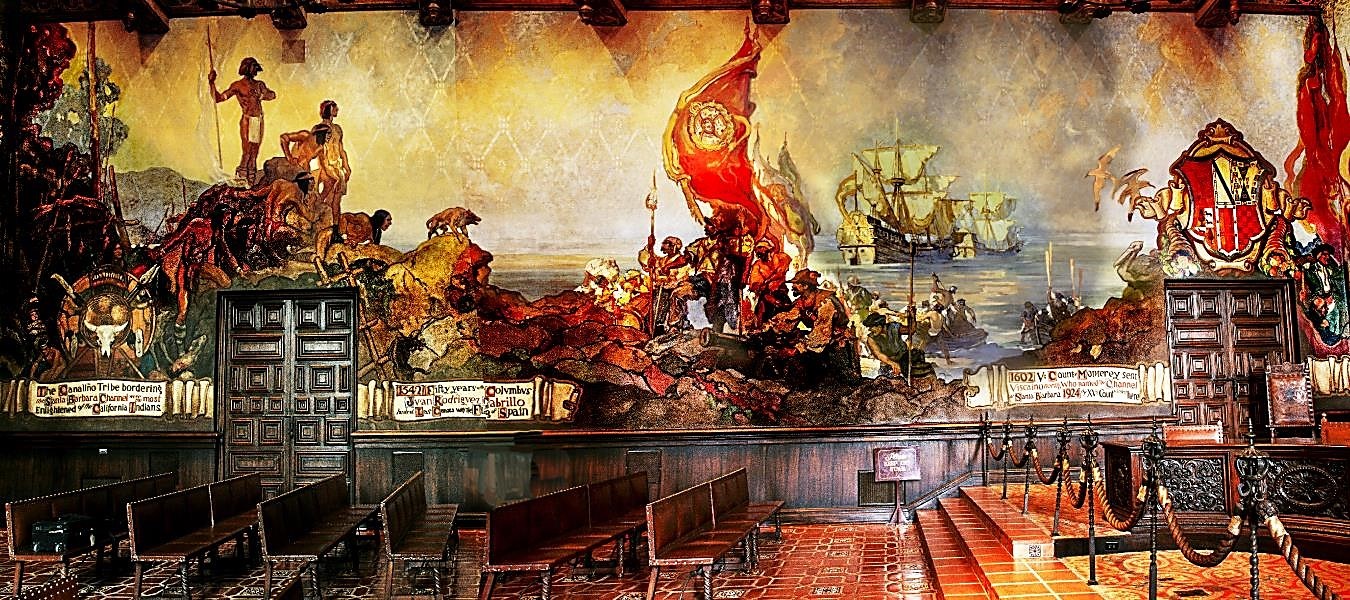
 The Chumash – called the ‘Canalino Tribe’ on the mural – thrived along California’s central coast for over 12,000 years. They built canoes to navigate the sea, traded actively, and mastered the use of local natural resources.
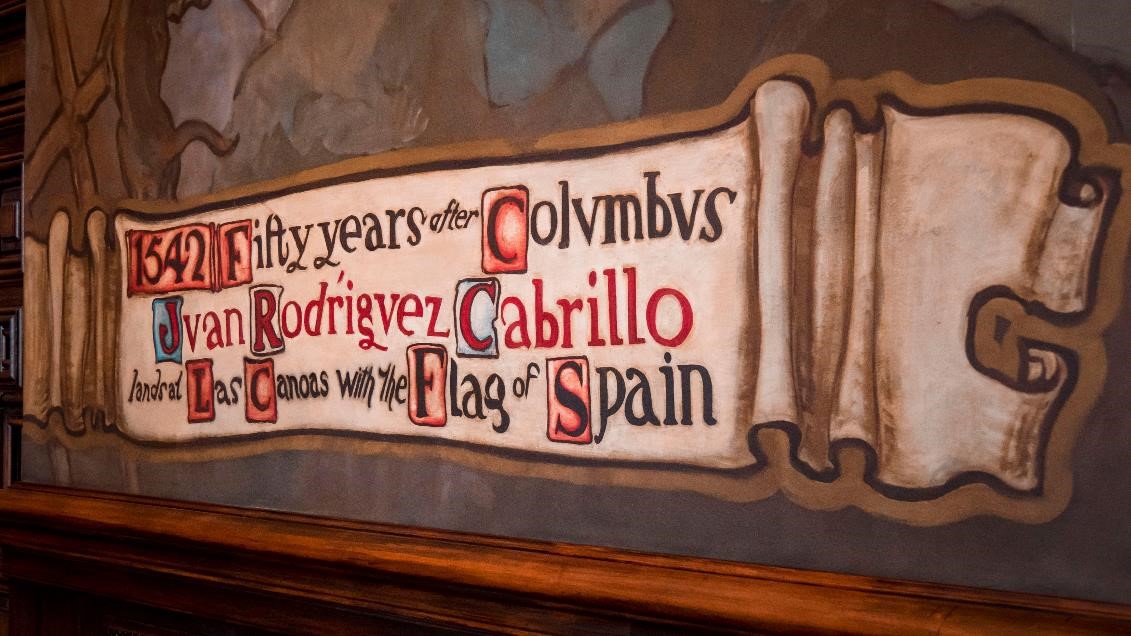
In 1542, Juan Rodriguez Cabrillo, the first European to sail up the coast of California, first claimed the territory for the Spanish crown. For many years after Cabrillo’s visit there was little Spanish activity here.
The Chumash – called the ‘Canalino Tribe’ on the mural – thrived along California’s central coast for over 12,000 years. They built canoes to navigate the sea, traded actively, and mastered the use of local natural resources.
In 1542, Juan Rodriguez Cabrillo, the first European to sail up the coast of California, first claimed the territory for the Spanish crown. For many years after Cabrillo’s visit there was little Spanish activity here.
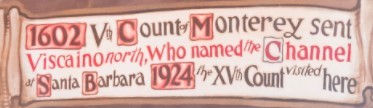
 In 1602, Sebastian Vizcaino, a Spanish explorer and mapmaker, sailed the coastline and anchored in the channel on December 4, which was the feast day of Saint Barbara.
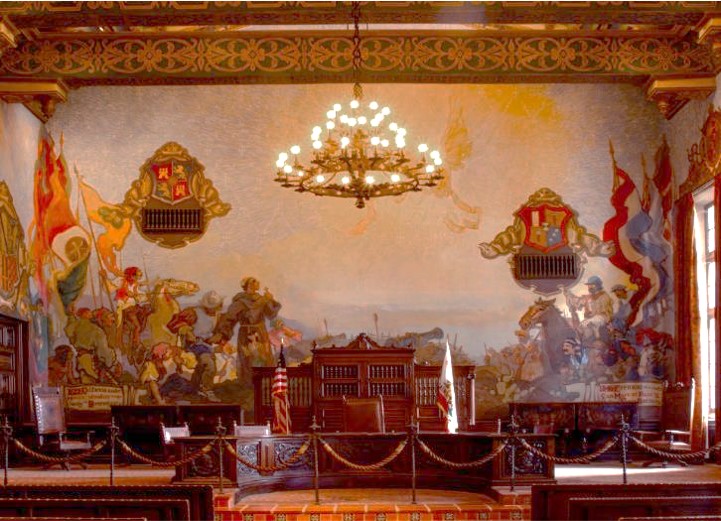
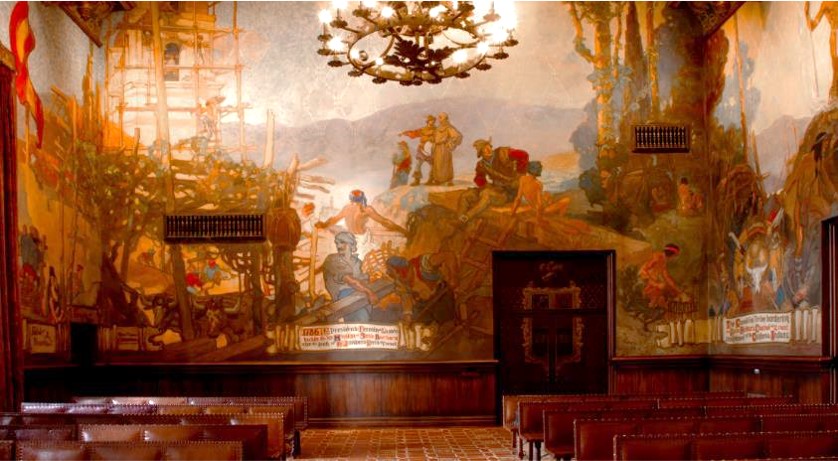
This wall depicts Santa Barbara’s early history, starting with the Chumash, who lived in the Santa Barbara area for 12,000 years before the Spanish arrived. In the center Juan Rodriguez Cabrillo is shown coming ashore in 1542. On the right mapmaker Sebastian Vizcaino is shown arriving in 1602. Vizcaino named one of the offshore islands in honor of Saint Barbara, which later led to the name given to the city, county and channel.
 Settlement and trade flourished in independent Mexico.
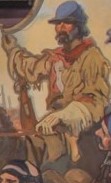 During the Mexican-American war, John C. Fremont, a noted western explorer and leader, brought U.S. forces over San Marcos Pass to claim Santa Barbara and help end the war in the west.
 High-back chairs in the left and right corners are judge’s chairs from the two original courtrooms when the Courthouse opened in 1929.
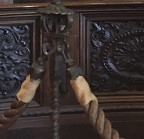 Ropes for mooring ships, called hawsers, were used for railings throughout the Courthouse to symbolize Santa Barbara's ties to the sea. They were later replaced with metal rails for improved safety.
The tall center cabinet contains a desk used by the Chair of the Board of Supervisors; it also housed the original sound system.
Ropes for mooring ships, called hawsers, were used for railings throughout the Courthouse to symbolize Santa Barbara's ties to the sea. They were later replaced with metal rails for improved safety.
The tall center cabinet contains a desk used by the Chair of the Board of Supervisors; it also housed the original sound system.
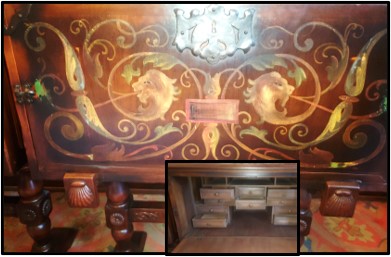 Hand-carved portable desks, called varguenos, were moved close to the County Supervisor’s chairs during meetings. The fleur de lis handles pull out to support a writing surface.
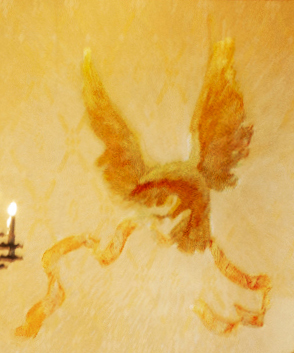 The eagle symbolizes United States control of the California Territory
Mexico’s independence from Spain brought a period of active local development and trade from 1822 to 1846, followed by United States control at the end of the Mexican-American war when the U.S. purchased a huge territory comprising California and most of seven future states for $15 million.
The oak and walnut furniture was custom-crafted in San Francisco. All the Mural Room fixtures and furnishings are original, including the carpet, except for the vinyl on the long wooden benches which were originally covered in leather.
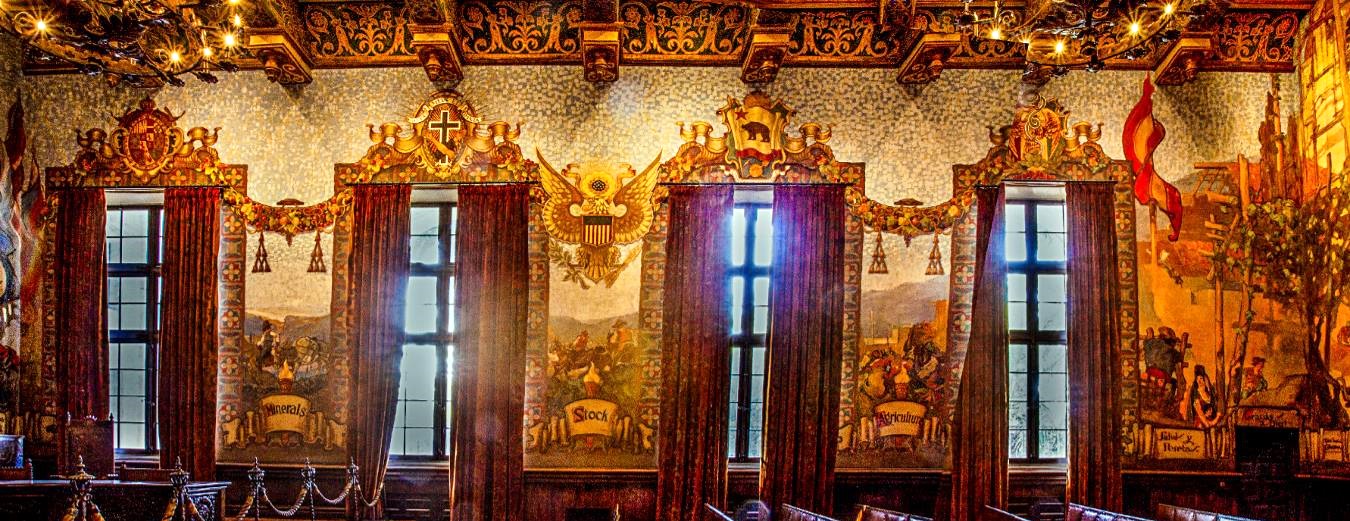
 Minerals provided abundant natural resources, including oil, silver and diatomaceous earth.
Cattle thrived in the ranchos near Santa Barbara from the 1830s and were sold for hides for leather, and tallow for soap and candles.
A consistent Mediterranean climate helps crops thrive, and Santa Barbara is known for strawberry and broccoli fields, avocado and citrus groves, and wine grapes.
The original heavy velvet drapes that hang on the windows are hand-stamped with a copper-zinc alloy to simulate gold.
Minerals provided abundant natural resources, including oil, silver and diatomaceous earth.
Cattle thrived in the ranchos near Santa Barbara from the 1830s and were sold for hides for leather, and tallow for soap and candles.
A consistent Mediterranean climate helps crops thrive, and Santa Barbara is known for strawberry and broccoli fields, avocado and citrus groves, and wine grapes.
The original heavy velvet drapes that hang on the windows are hand-stamped with a copper-zinc alloy to simulate gold.
 ‘Salud y Peseta' translates loosely to 'Health and Wealth,' 'Gracias a Dios' translates to 'Thank God.'
 Groesbeck was apparently inspired by the original Peter Pan black & white silent movie filmed on the Channel Islands at the time.
Between the windows are depictions of the local economy – mineral wealth, ranching (‘stock’), and agriculture. Above the windows are stylized versions of major historical influences, the coat of arms of Spain, the emblem of the Order of St. Francis (founders of the California Missions), the California Bear Flag, and the coat of arms of Mexico. In the middle are elements of the Great Seal of the United States.

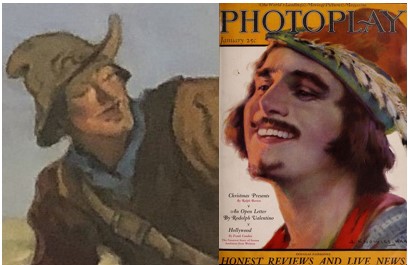
Groesbeck’s movie ties may have inspired him to depict famous actors of the time. Visitors may see a resemblance to Douglas Fairbanks in Robin Hood, a famous 1922 silent movie.
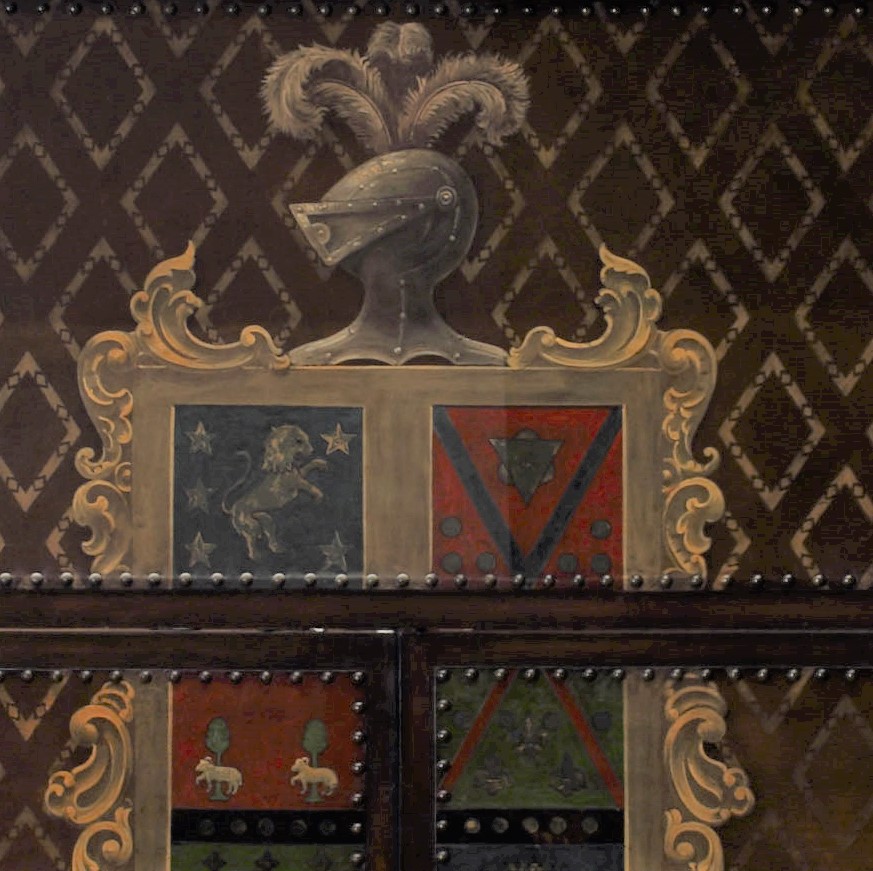 The main entrance door is covered with embossed leather with the coat of arms of Spain’s 15th century King and Queen, Ferdinand and Isabella.
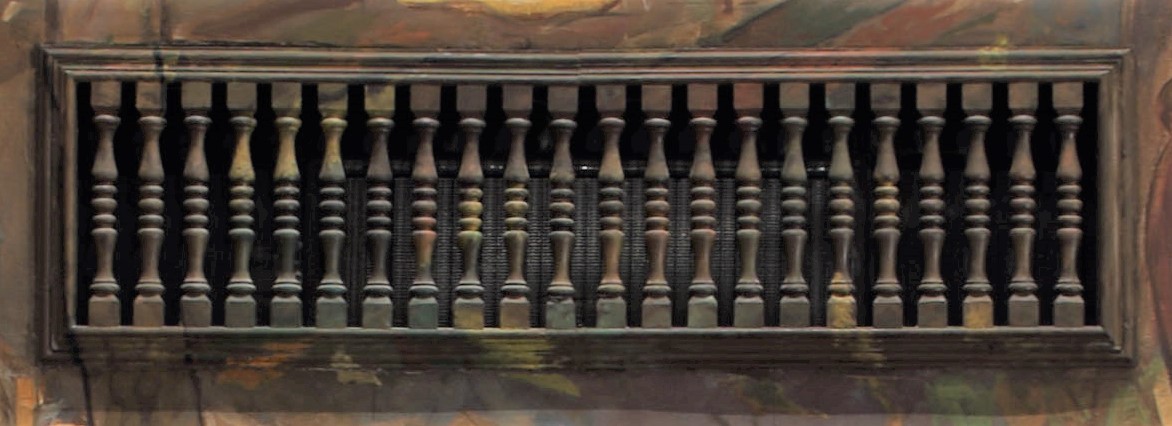
Wooden spindles cover vents of a heating system no longer in use.
The main entrance door is covered with embossed leather with the coat of arms of Spain’s 15th century King and Queen, Ferdinand and Isabella.
Wooden spindles cover vents of a heating system no longer in use.
 Movable long benches allow the room to be configured for many different events. Originally covered in cowhide (which determined the size), they are now covered in vinyl.
Tile floors here, and throughout most of the Courthouse, are terracotta, made by Gladding, McBean & Co., of Lincoln, California, near Sacramento. The decorative insert tiles are in the 'Cuenca' style, with painted depressions.
Movable long benches allow the room to be configured for many different events. Originally covered in cowhide (which determined the size), they are now covered in vinyl.
Tile floors here, and throughout most of the Courthouse, are terracotta, made by Gladding, McBean & Co., of Lincoln, California, near Sacramento. The decorative insert tiles are in the 'Cuenca' style, with painted depressions.Santa Barbara’s original Mission, founded in 1786, was the 10th of California's 21 missions. It was destroyed by a major earthquake in 1812, and re-built as today’s two-towered 'Queen of the Missions.'
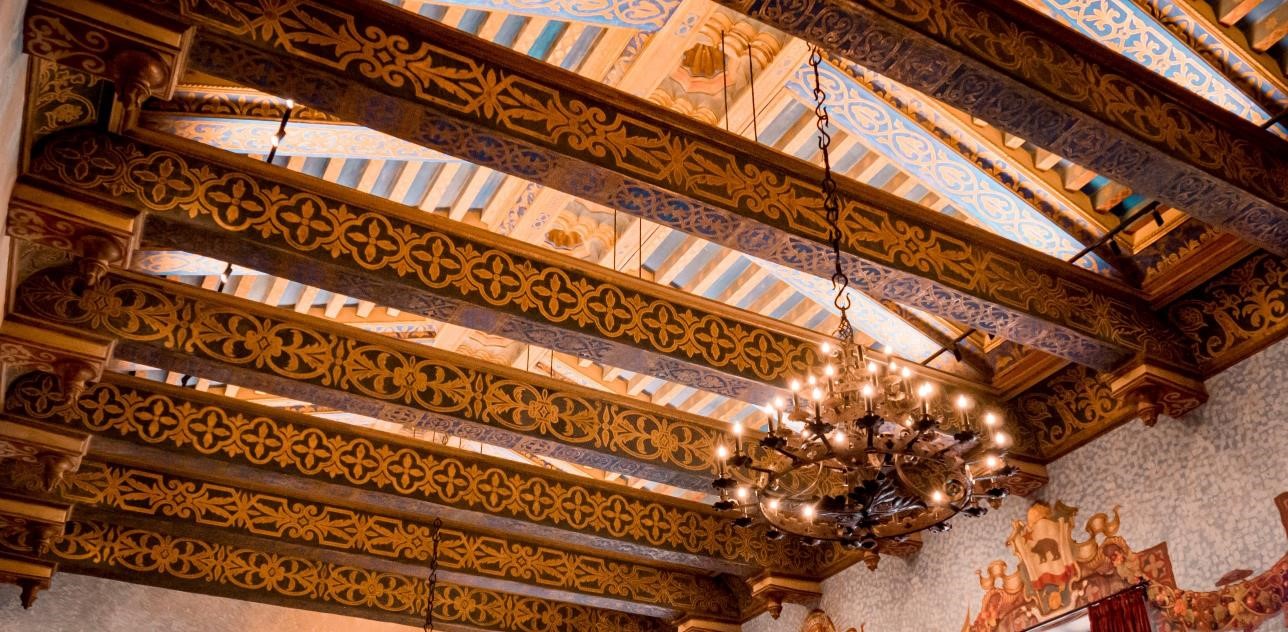

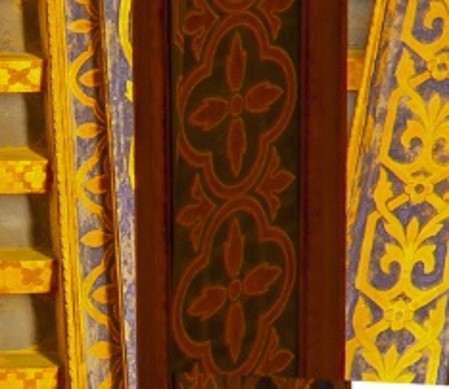 The ceiling beams have a wood appearance but are lathe and plaster over steel trusses, part of the earthquake-resistant design of Santa Barbara’s ‘new’ 1929 Courthouse.
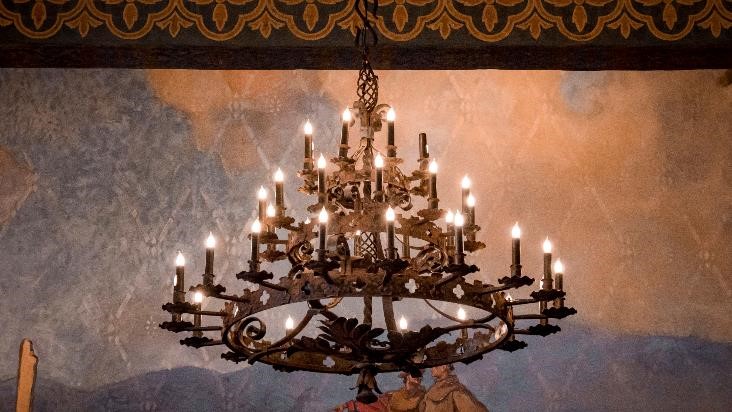 The chandeliers were custom made in Los Angeles of wrought iron, wood and hammered tin, each weighing 1,000 pounds.
In the Mural Room, Smeraldi recalls the 12th-century Palatine Chapel and Cathedral of Monreale in Palermo, Sicily. Smeraldi used paint with a copper-zinc alloy added to simulate gold leaf. Spotlights were added in 2014 to illuminate the ceiling’s beauty.
Photo Credits - Robert Dickey and Robert Ooley except as otherwise noted.
We hope you enjoyed your tour experience and we welcome your feedback. Please go to our feedback page.